by Alan Langstaff
In recent issues of the Langstaff Letter, we have been looking at Israel and Jerusalem. There is one last issue that we wish to deal with. It concerns Jerusalem and the future.
NEW JERUSALEM
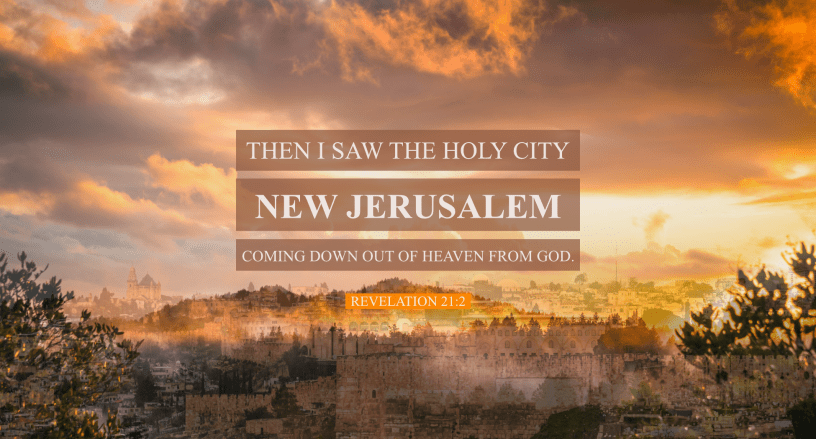
In the last book of the Bible – the book of Revelation, we find the concept of the New Jerusalem. It is described as a heavenly city that will come down to earth at the end of time. As such, it is the ultimate fulfillment of God’s promise for his people and the implementation of His Kingdom.
The idea of the New Jerusalem coming down from heaven to earth is, as one writer puts it, “a powerful symbol of God’s presence among his people.” It represents the culmination of God’s plan for redemption and restoration when heaven and earth will be united in a new and perfect creation. The coming down of the New Jerusalem also signifies the end of the old order of things, including sin, suffering, and death. It represents a new beginning when God will dwell with His people and wipe away every tear from their eyes.
DIMENSIONS OF THE NEW JERUSALEM
The following article on the internet describes it this way:
“The New Jerusalem, which is also called the tabernacle of God, the Holy City, the city of God, the Celestial City, the city foursquare, and heavenly Jerusalem, is literally heaven on earth. It is referred to in the Bible in several places (Galatians 4:26; Hebrews 11:10; 12:22–24; and 13:14), but it is most fully described in Revelation 21.
In Revelation 21, the recorded history of man is at its end. All the ages have come and gone. Christ has gathered His church in the Rapture (1 Thessalonians 4:15–17). The tribulation has passed (Revelation 6—18). The battle of Armageddon has been fought and won by our Lord Jesus Christ (Revelation 19:17–21). Satan has been chained for the 1,000-year reign of Christ on earth (Revelation 20:1–3). A new, glorious temple has been established in Jerusalem (Ezekiel 40—48). The final rebellion against God has been quashed, and Satan has received his just punishment, an eternity in the lake of fire (Revelation 20:7–10.) The great white throne judgment has taken place, and mankind has been judged (Revelation 20:11–15).
In Revelation 21:1 God does a complete make-over of heaven and earth (cf. Isaiah 65:17; 2 Peter 3:12–13). The new heaven and new earth are what some call the eternal state and will be “where righteousness dwells” (2 Peter 3:13). After the re-creation, God reveals the New Jerusalem. John sees a glimpse of it in his vision: “The Holy City, the new Jerusalem, coming down out of heaven from God, prepared as a bride beautifully dressed for her husband” (Revelation 21:2). This is the city that Abraham looked for in faith (Hebrews 11:10). It is the place where God will dwell with His people forever (Revelation 21:3). Inhabitants of this celestial city will have all tears wiped away (Revelation 21:4).
The New Jerusalem will be fantastically huge. John records that the city is nearly 1,400 miles long, and it is as wide and as high as it is long—the New Jerusalem being equal in length, width, and depth (Revelation 21:15–17). The city will be dazzling in every way. It is lighted by the glory of God (verse 23). Its twelve foundations, bearing the names of the twelve apostles, are “decorated with every kind of precious stone” (verse 19). It has twelve gates, each made of a single pearl, bearing the names of the twelve tribes of Israel (verses 12 and 21). The street will be made of pure gold (verse 21).
The New Jerusalem will be a place of unimagined blessing. The curse of the old earth will be gone (Revelation 22:3). In the city are the tree of life “for the healing of the nations” and the river of life (verses 1–2). It is the place that Paul spoke of: “In the coming ages [God] might show the incomparable riches of his grace, expressed in his kindness to us in Christ Jesus” (Ephesians 2:7). The New Jerusalem is the ultimate fulfillment of all God’s promises. The New Jerusalem is God’s goodness made fully manifest.”
(By Tony Perkins, GotQuestions.org)
“Judea and Samaria are not only 24 times larger than Gaza but are embedded in the geographic and spiritual core of Israel. Surrendering this strategic depth would not foster peace — it would invite prolonged conflict and existential risk.
The United States should support Israel’s rightful claim to sovereignty over Judea and Samaria. This is not only a matter of historical justice, but of national security — for Israel and for all who value stability in the Middle East. Failing to do so will perpetuate a failed status quo, embolden enemies of peace, and betray the very principles that have undergirded America’s strongest ally in the region.”
(By Tony Perkins, WashingtonStand.com)
LIVING IN THE TIME OF FULFILLED PROPHECY
“What an exciting time we live in! After nearly 2,000 years of scattering—the Diaspora—the modern State of Israel was reborn in 1948. This is no accident. It is a dramatic fulfillment of God’s promises:
“I will take you from the nations and gather you from all the countries and bring you into your own land” (Ezekiel 36:24, ESV; see also Ezekiel 37:21-28; Isaiah 11:11-12; Jeremiah 16:14-15, ESV).
Ezekiel’s vision of the valley of dry bones coming back to life first physically, then spiritually, is unfolding before our eyes. Jesus Himself gave us the sign of the fig tree, often a picture of Israel—saying, “When you see all these things, you know that it is near, right at the door” (Matthew 24:32-33, ESV).
We are living in that season. The time is short. Jesus is coming back to Jerusalem—to reign as King.”
(By Bishop Chad MacDonald, MyCharisma.com)
“I AM COMING QUICKLY”
Jan Markell is a radio personality as well as a supporter of Israel. She founded Olive Tree Ministries, as well as authoring nine books. Her radio program was on (until recently) approx. 1000 radio stations in the USA.
In the foreword to the latest book, When Jesus Returns, it is declared:
“Jesus said, “I am coming quickly.” He said it not once, not twice, but three times (Revelation 22:7, 12, & 20). There is no way to miss this promise. One time establishes a point, a second time drives it home, but the third time ensures that everyone sits up and takes notice. “Yes, what you’ve heard is true. I will be returning, and you had better get ready because it won’t be too long.” If Jesus felt it was important to give this promise a three-peat, then it should be important to us as well.”
FINAL THOUGHT
Quotes from an article by Tim Moore.
“Paul advocated for what I refer to as an “already, but not yet” realization of our salvation. Yes, we are saved the moment we trust in Christ. But still, we await the glorification of our bodies, our minds, and our hearts. “For in hope we have been saved, but hope that is seen is not hope; for who hopes for what he already sees? But if we hope for what we do not see, with perseverance we wait eagerly for it” (Romans 8:24-25).
Jesus Christ, who is our Savior in accordance with the eternal will of God, is also our Hope.
Are You Hoping for the Blessed Hope?
Paul’s letter to the Thessalonians is the clearest scriptural reference to the Rapture, but it is not the only one. The concept of the “Rapture” is contained in 1 Thessalonians 4:17 where the word is typically translated as “caught up.” In the original Greek, the word harpázō was used. That word appears 14 times in Scripture and conveys the idea of being seized, snatched away, plucked up, or carried off by force.…
“Late in the 4th century, Jerome translated the Greek New Testament into the Latin Vulgate (“vulgar” or common tongue spoken by most Roman citizens). He used the future tense of the Latin verb rapio, rendering it as rapiēmur— meaning “we shall be caught up.”
If Paul’s Spirit-revealed reference to what we call the Rapture was the only one, it would still be a clear and valid prophecy. But other Scriptures reference this promise to the Church: “Jesus said, ‘I will come again and receive you to Myself, that where I am going (to prepare a place for you) you may be also’” (John 14:1-4).…
Jesus is the Bridegroom who is waiting for His Father to say, “Go, and get Your Bride.” Any man who has awaited his wedding day can testify that the sense of anticipation and joyful excitement begins at the engagement and mounts as the wedding day draws near. The same was true with a Jewish betrothal, although the timing of the actual wedding was undetermined (and unknowable) until the father decided it was time.
As she awaits the wedding day, every bride also experiences growing expectation and hope. Her hope is not a forlorn wish, but an assurance of a life to be united and shared with the bridegroom. That is why brides used to gather treasured belongings in a hope chest— readying them for use in her future home and family.
It is almost unimaginable to think of a bride who would be apathetic about her impending wedding. And yet, many in the Bride of Christ seem unconcerned and indifferent about the joy that awaits when our Bridegroom comes to snatch us away, gathering us to Himself in the blink of an eye.
Oh, what a joy-filled day that will be! But that is only the beginning of the glories and joys that await us according to Bible prophecy.”
(By Tim Moore, HarbingersDaily.com)
On one of my visits to a new church in Turkey, which we had helped to plant. I went with a group of missionaries to the Island of Patmos. They went to renew their visas, and I went as a visitor. I was guided to the grotto where it is claimed John wrote the Revelation. It was awesome to stand there and remember the words at the end of Revelation:
“Surely I am coming quickly.”
Yes, Lord, come quickly, we are expecting You.
Come, Lord Jesus.


Amen, Pastor Alan! As I was doing my devotions today, I read Psalm 92. Verse 14 reminded me of you –
They will still bear fruit in old age, they will stay fresh and green
You are a blessing! Thanks for all your wisdom!
Julie
Hi Julie
Thanks for your encouraging word. Alan Langstaff
>