by Alan Langstaff
I will not forget the first time I visited Israel in 1971. We stayed in Jerusalem, and as we walked around the area, we could see the evidence of the 1967 War with bullet holes in the buildings.
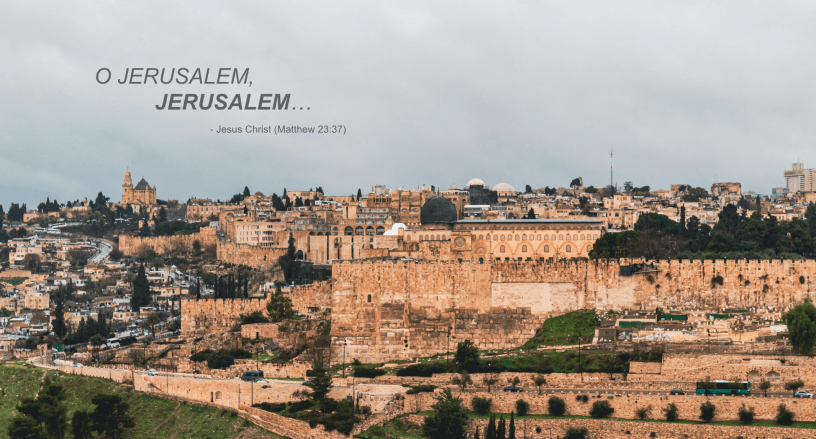
Jerusalem is a very significant city. Jesus, in His day, spoke of the city of Jerusalem in the following way…
“O Jerusalem, Jerusalem, the one who kills the prophets and stones those who are sent to her! How often I wanted to gather your children together, as a hen gathers her chicks under her wings, but you were not willing! See! Your house is left to you desolate; for I say to you, you shall see Me no more till you say, ‘Blessed is He who comes in the name of the Lord!’ ” (Matthew 23:37-39 ESV)
BRIEF HISTORY OF JERUSALEM
Jerusalem is one of the world’s oldest cities, but its significance increased during the time when David became King around 1000 B.C. It was there that David’s son Solomon built the first temple, establishing the city as a major religious center.
Following the split after Solomon’s reign, Jerusalem became the capital of Judah. Up until it was captured by Nebuchadnezzar and the Babylonian invasion in 586 B.C. The Babylonians destroyed the First Temple, and people were taken into exile in Babylon. However, when the Persians captured Babylon, Cyrus the Great allowed the Jews to return and rebuild the city of Jerusalem.
Jerusalem came under Hellenistic (Greek) rule following the conquests of Alexander the Great. For a brief period in the 2nd Century B.C. Jewish autonomy was restored with Jerusalem as the capital of an independent state.
Then in 63 B.C. Jerusalem was conquered by Pompey and became part of the Roman Empire. Jerusalem remained under Roman control until the Jewish-Roman Wars, which culminated in the destruction of the Second Temple in A.D. 70.
MANY NAMES OF JERUSALEM
It is stated that there are 70 names of Jerusalem.
They include:
- Salem – In Genesis, Salem was the city noted by Melchizedek in the days of Abraham.
- Moriah – The name of the Temple Mount. It is the place where Abraham took Isaac to offer a sacrifice.
- Jebus – The name of the fortress atop the Temple Mount. King David conquered the area from the Jebusites.
- Yerushalayim – The most common name of the city in the Bible and the area still used by Jews today. Jerusalem is the name used by most.
Zion was originally the name of the hill where the Jebusite fortress stood. From the Second Temple era, the name came to apply to a hill outside the walled city. Later, it is used as a synonym of the city of Jerusalem as a whole.
Today, three major monotheistic religions – Christianity, Islam, and Judaism – all consider Jerusalem to be a sacred place.
At the heart of Jerusalem is the Old City of Jerusalem, which reflects the Ottoman design. This old city is only about one square kilometer and the most holy places for the three world religions.
Judaism, the most well-known site for Jewish believers, is the Western Wall. This is the last remnant of the Second Temple.
The Temple Mount is revered by all three major religions.
Jerusalem is also home to one of the most important places in the Holy Land – the Church of the Holy Sepulchre. This church is built around two places. Golgotha, the site of Calvary, the crucifixion site. Also, there is a reference to the place thought by many to be the burial and resurrection sites for Jesus. It should be noted that scholars do not necessarily identify this with actual locations.
Upon the Temple Mount sits the Dome of the Rock mosque, and it is considered one of the holy sites in Islam.
THE SIGNIFICANCE OF JERUSALEM
Israel can be viewed in at least two ways:
Firstly, as a pilgrimage site. This is where a person visits the sites in Israel, especially as they occur in the Bible. As such, they are looking back at the past.
Secondly, as a prophetic view regarding Israel as a Nation today. A nation that did not have a homeland for 2000 years. It is also a call to consider the Bible’s promises regarding the future, even up until we have a new heaven and a new earth. (This we will look at in a later Langstaff Letter).
It is possible to combine the two, so let’s look at the significance of Jerusalem today and into the future.
I want to share some main points regarding Jerusalem and its significance. Though there are many more.
1. JERUSALEM – WHERE JESUS CRIED
Jesus is not recorded as weeping very much. In Luke 19:41, He drew near to the city, and He wept over it. It may seem strange to think of Jesus as a weeping prophet, but it records what He said at that time. It was prophetic what He felt and said.
“And when he drew near and saw the city, he wept over it, saying, “Would that you, even you, had known on this day the things that make for peace! But now they are hidden from your eyes. For the days will come upon you, when your enemies will set up a barricade around you and surround you and hem you in on every side and tear you down to the ground, you and your children within you. And they will not leave one stone upon another in you, because you did not know the time of your visitation.” (Luke 19:41-44 ESV)
Jesus didn’t weep over other cities. In fact, in some cases, He rebuked them for their unbelief, but when He saw Jerusalem, He wept over it.
We too should have that kind of attitude: “Jerusalem, Jerusalem.”
2. JERUSALEM – THE DEATH & RESURRECTION OF JESUS
Jerusalem is significant because it is where Jesus was crucified and it was the place where he was raised from the dead. So, the Scriptures that spell out these central foundations of the Christian faith are all centered on Jerusalem.
As I mentioned earlier, I first visited Jerusalem in 1971. But I have been back a number of times. In 1986, I went with my wife, Dorothy, to a conference that Dr. Cho was holding in Jerusalem. The trip to the Garden Tomb was one of the highlights of the visit. The presence of the Lord was evident when you were there, and you remembered that Jesus rose from the dead.
Jerusalem is so special. It is the place where Jesus died to take away our sins. It is there too that He rose triumphant from the grave.
3. PRAY FOR JERUSALEM
In Psalm 122:6, the call goes out to believers to “Pray for the peace of Jerusalem! May they be secure who love you!”
So, inspired by Jesus’ response to Jerusalem, we too are called to pray for her. We are to “pray for the peace of Jerusalem.”
Now that can mean many things, including praying for the protection of Jerusalem. Praying for peace, unity, and healing within Jerusalem. Praying for Christian ministries, etc.
Yes, we are to pray for Jerusalem.
4. JERUSALEM – THE FUTURE
There are other reasons regarding Jerusalem that relate to:
1) The place where Jesus returns to.
2) The place where Jesus, the conquering King, will rule and reign in the Millennium and the days to come.
We will look at these in a later Langstaff Letter.
The most important thing we can do regarding Jerusalem is to pray.
Pray for Jerusalem.

