by Alan Langstaff
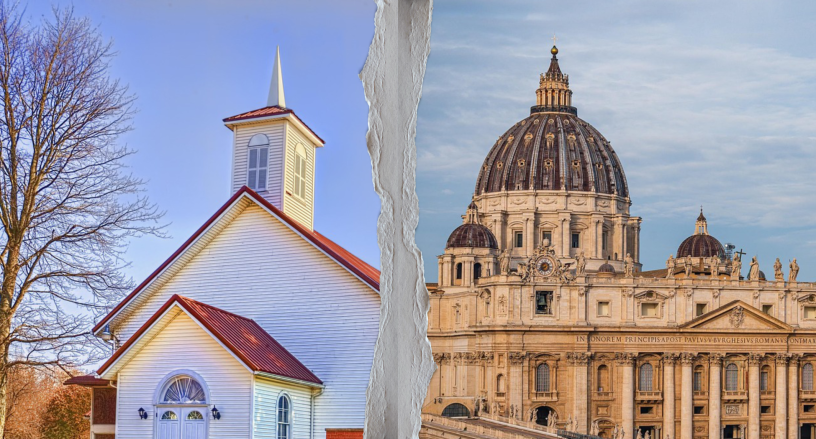
This week, the funeral was held in Rome for Pope Francis, who had died the day after Easter at the age of 88. Today I want to tackle the subject of “A Protestant and Catholics.”
In the year after I was ordained in the Methodist Church in Australia, I was sent to be Associate Pastor of a Methodist church in Bondi Junction in Sydney, Australia.
I well remember one of my first meetings with the Senior Pastor. He explained to me that the eastern suburbs, the area of the church, were somewhat different from other parts of Sydney inasmuch as there was a strong contingent of Catholics. He told me that I would have to get used to that, particularly when our Methodist Church and the Catholic Church did things together. Get along with Catholics? I thought to myself, “never.” (I was an evangelical Christian, and I wasn’t at that stage even sure Catholics were saved.)
Our church and the Catholic Church even shared pulpits together twice a year and did specific things together during the year. So much so, when my Senior Pastor went on a world trip in 1972, he visited Rome and was given a one-on-one meeting with the Pope.
Well, later my attitude towards Catholics changed, as you will read later.
But with the death of Pope Francis, it seemed a good time to point out differences that exist concerning what Roman Catholics believe and what Evangelical Christians believe. Let me highlight a few differences.
1) BECOMING A CHRISTIAN
The differences have gone back to the Reformation and the time when Martin Luther nailed his 95 theses to the door of a church in Germany.
Catholics with their sense of community have long looked at Baptism primarily for infants as being their entrance to the church.
Evangelical Christians have emphasized the need to be “born again” (involving repentance and faith). They believed in Baptism but not as a saving grace. For the Protestant, it is the doctrine of “justification by faith.”
This is the primary difference between Roman Catholics and Evangelical Christians – the question of how you become a Christian.
2) EUCHARIST & HOLY COMMUNION
For a Roman Catholic, the Eucharist is the center of worship.
They believe that the Eucharist is the real presence of Christ. That the bread and the wine in some way become the body and blood of our Lord.
Evangelical believers, by and large, have not emphasized the importance of Holy Communion and often only celebrate it once a month. To be honest, in many cases, it is not considered to be so important, at least that is demonstrated in how often it is practiced. The elements are considered symbolic, not real flesh and blood.
3) THE PLACE OF THE POPE
For Roman Catholics, the Pope has the unique position as head of the church and, as such, recognizes his authority. He is seen as the successor of Peter, or the Vicar of Christ on earth, based on the interpretation of Jesus’ words in Matthew chapter 16: “Blessed are you, Simon Bar-Jonah, for flesh and blood has not revealed this to you, but My Father who is in heaven. And I also say to you that you are Peter, and on this rock I will build My church” (v.17-18).
Evangelical Christians believe that the Bible alone is the authority for the Church and for Christian living.
So, what do Protestants think of the Pope? Roger Moore, the editor of “Christianity Today” writes:
“Evangelicals—for the most part—no longer think of the pope as the “antichrist” or of the Roman church as the “whore of Babylon” from the Book of Revelation. But better relations might be a sign of something else—of the ways a secularized Western culture has affected all of us, to the degree that we no longer feel the existential weight of the arguments that once led to reformations and counter-reformations, inquisitions and uprisings.”
(Moore to the Point, April 23, 2025)
There are other points of difference involving the role of Mary, the place of women in leadership, etc.
CRITICS WITHIN THE CATHOLIC CHURCH
There were critics of Pope Francis within the Catholic Church, mostly emanating from the Church’s conservative wing, including Archbishop Georg Gänswein, who published a tell-all memoir and consequently was exiled from the Vatican. It seems Pope Francis was too progressive for some Catholics.
ROMAN CATHOLIC ACHIEVEMENTS
There are certain achievements that need to be recognized, including the care for the poor (see Mother Teresa), and in particular, Roman Catholics have been at the forefront of opposition to Abortion. Indeed, at the beginning, they almost stood alone.
MY OWN EXPERIENCE
It was after I experienced the Baptism of the Holy Spirit that my attitude to Catholics changed. Indeed, I received the Pentecostal experience in a Catholic Church at the University of Sydney at a meeting led by a Catholic layman, a professor of applied mathematics who had been to America and received the experience of the Holy Spirit through Catholic charismatics.
So during the 1970’s the ministry that my wife and I established worked with people from all denominations, including Roman Catholics, and indeed we worked with the charismatic Catholics, having combined their conferences with ours.
During the 1970’s we invited Catholic speakers from America to speak at our conferences, including Father Frances MacNutt and Kevin Ranaghan.
In 1975, I was invited to attend the International Catholic Charismatic Conference in Rome. I was one of less than a dozen non-Catholic’s invited. It was an amazing experience, and you can read all about it in my wife Dorothy’s book “Called Together.”
Here is an excerpt from her book:
“The finale of our stay in Rome was a visit to Saint Peter’s Basilica on Pentecost Sunday. This was Holy Year and it must have been a thrilling experience for a Catholic to be in Rome for such an occasion. Fifty thousand people crowded in and around the cathedral. There were no seats and the crowd stood crammed shoulder-to-shoulder on the marble floor. The only space in the entire building was the center aisle.
As part of the international delegation, we received preferential treatment. We were admitted at a side entrance by guards in colorful uniforms and given purple-cushioned seats at the front of the church.
I was moved by the reverence and respect the people displayed for their leader. As the Pope was carried down the aisle, they acclaimed him with shouts of joy. Behind us, a girl fainted, overcome with excitement. This certainly was a once-in-a-lifetime experience, and I could understand their emotion.
The Pope’s address on the joy of the Holy Spirit was followed by the Eucharist. …Australian Catholic charismatic priests urged us to take part. It was with great reverence that I stepped forward to receive that wafer on my tongue, aware of the tremendous privilege of tasting the unity that God had promised.”
It was during that time that I came to realize that Catholics could know the Lord and that I should not look down on people from other denominations.
Later, the Lord spoke a word to me, “You wanted them (i.e. Catholics) to be like you but I want all to be like me.”
At a time when people around the world are mindful of all that is happening in Rome, let us pray for unity in the church, that together we might glorify our Lord and Savior Jesus Christ.
 Kairos Ministries